
Number of personnel at the Group
984
Employee breakdown by gender: women
78
Employee breakdown by gender: men
22
Average length of employment
7
A Lifelong Story
Over half a century, much has changed, but the joy of work, pride in one’s craft, and the importance of community have endured. Teuvo Heinäaho, Anne Virkkula, and Esa Laaksonen look back on their long careers at Otava and share what has kept them with the company for decades.
“My pants tore on my first day”
Teuvo Heinäaho, machine operator at Otava Printing Keuruu printing house, hasn’t been able to quit working – even though he could have retired years ago. He has enjoyed his job at the printing house for 50 years.
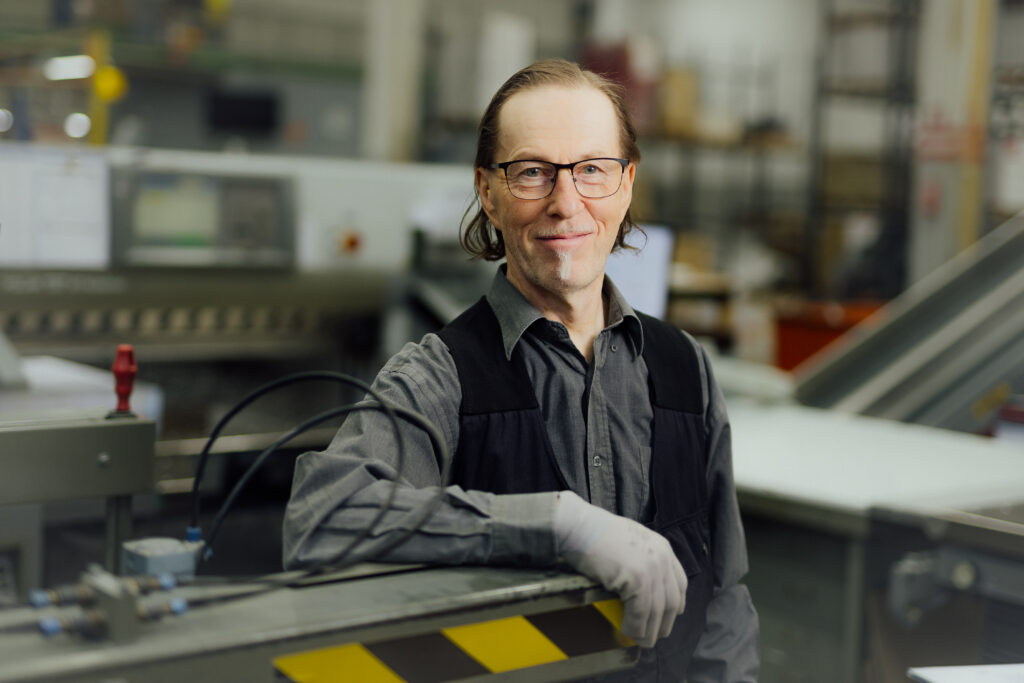
How did you originally end up at Otava Printing?
My father once helped build an employee sauna for Otava in Keuruu and wondered whether I might get a job there. He asked Eero Jukola, who was the local printing house manager at the time. I was invited to visit, and I started in the book warehouse packing books.
After completing my military service, I got a job as a forklift driver transporting paper sheets and finished books. As my tasks changed, I started to understand what exactly happens in a printing house. From carting paper around, I moved to operating the trimming machine used for cutting paper and book covers. Over time, production became quite standardized, and two full-time trimmers were no longer needed, so I also worked on cover production and foil stamping. That was interesting work, too.
Do you remember your first day at work?
I remember it well, on my first day, the seat of my pants tore open. I was sitting on a wooden chair packing books, and apparently the chair surface was rough because my trousers ripped. It made me laugh, and I remember thinking, what a tough job, my pants wore out on the first day!
What has kept you at your job for so long?
I’ve simply enjoyed the work, and the paycheck doesn’t hurt either. The work keeps my mind active, there’s always something to calculate, measure, and remember, which helps keep dementia at bay. I cut raw paper to different sizes for the printing machines, trim printed sheets for folding machines, and cut covers and endpapers. Time certainly flies. I can schedule my work myself.
What has been the most memorable moment in your career?
There are many, but one amusing incident happened when I had just started on the trimming machine. A group of vocational school students came for a tour. Their teacher said this job requires a great deal of skill. It made me smile—I’d only been doing it for a week, and it was going just fine.
What changes have you witnessed during your career?
Surprisingly few. The bindery equipment has worked mostly the same way, even though the machines have changed. The same foil-stamping machines from the 1950s or 60s are still in use. The biggest change has been digitalization in printing.
In the 1980s and 1990s, print runs were enormous, and we had pallets upon pallets of material to trim. You had to keep a fast pace, and your shirt was soaked by the end of the day. Nowadays there are more titles, but print runs are smaller, so there is more prep and setup work.
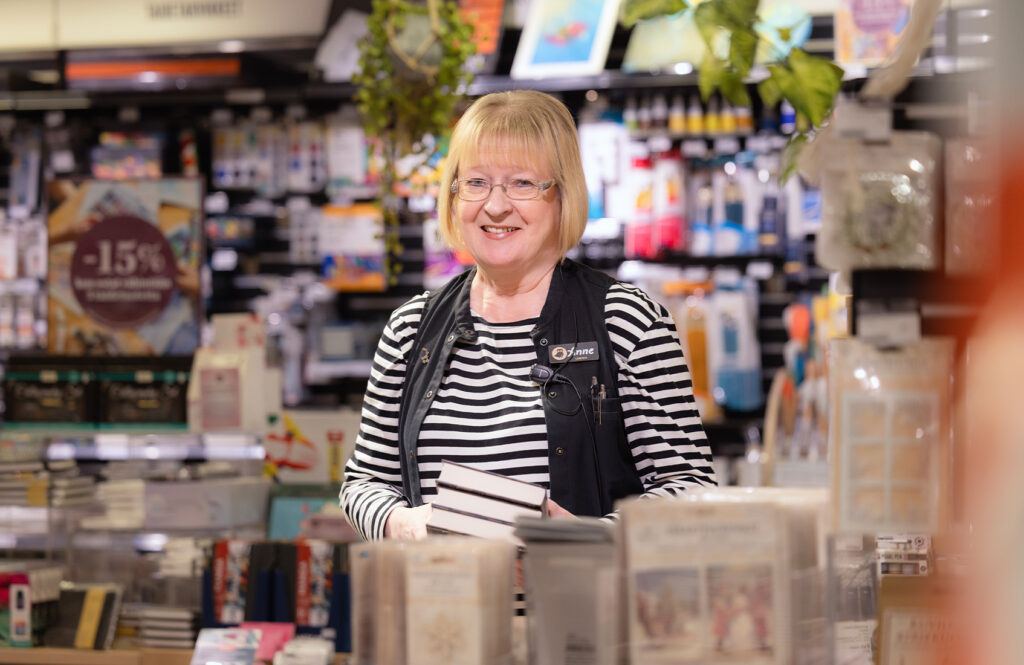
The bookstore became the foundation of my life
When Anne Virkkula started working at Pohjalainen Kirjakauppa (now part of Suomalainen Kirjakauppa) 50 years ago, she was the youngest at the store. Now, as the most senior employee, she wants to support younger colleagues the same way she was supported.
How did you originally join Suomalainen Kirjakauppa?
Friends working at Pohjalainen Kirjakauppa encouraged me to apply. They told me how nice the workplace was and how good the atmosphere was. The bookstore was Finland’s oldest private bookstore until Suomalainen Kirjakauppa bought it in 1999. The change didn’t really affect my work. The products and colleagues stayed the same. The bookstore became part of my identity, and I became known as “Anne from the bookstore.” I’ve been at the Oulu store the entire time, although the location has moved a few times.
Do you remember your first day?
My family had just moved, and the morning bus was late, so I arrived late—barely dared walk in. I was nervous, but they welcomed me warmly and started teaching me bookstore work.
At first, I worked at the switchboard and spent half the day in the warehouse pricing items and delivering goods between three floors. The phone rang constantly! I loved the job immediately—I fell in love with the community and the bookstore.
What has kept you at your job for so long?
The bookstore quickly became the cornerstone of my life. I was 16 when I started, and most of my colleagues were much older. They took me under their wing and became like a second family. Even though colleagues have changed over the years, the same good atmosphere has continued. Now I’m the oldest, and I want to support the younger ones.
My responsibilities have changed over the years, so I’ve never felt a need to switch workplaces. I worked for 13 years in visual merchandising, creating store window displays. And books have always been important to me. I learned to read before starting school.
Most memorable moment of your career?
Last spring, I was awarded “Bookseller of the Year,” which crowned my career. The award recognizes professional excellence in the book trade. I’m very proud of it.
My most visible work has been as a visual merchandiser. Our store once had seven display windows, all of which I decorated. All price tags were handwritten with felt-tip pens. The advertising manager taught me the basics of visual merchandising, and over the years I received several awards for my displays.
What changes have you witnessed during your career?
The “book industry” used to be a much broader concept we worked in the book industry, now simply in a bookstore. Even in the 1990s, the work involved close contact with publishers’ sales reps, author events, and professional knowledge competitions. The Libro association organized training and events for bookstore employees. I was active in the association and served as chair. Sadly, all of that has disappeared from our work.
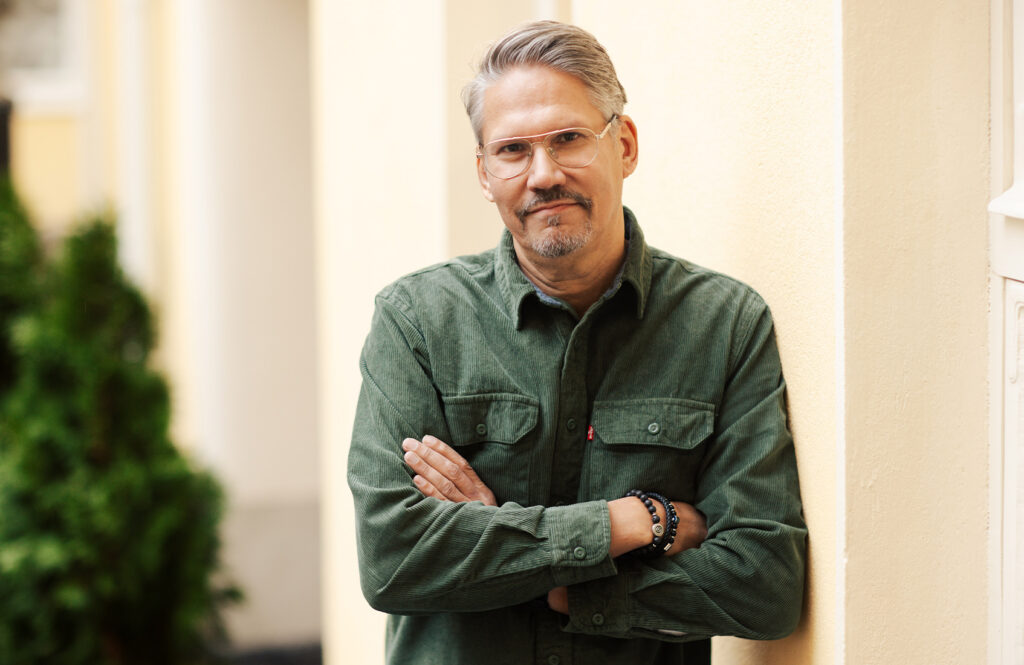
The boss’s Savonian dialect gave me trouble
Over his 35-year long career, Esa Laaksonen has witnessed the digital transformation of working life from a front-row seat. Internal mail envelopes have been replaced with digital tools, but one thing hasn’t changed: a wonderful work community.
How did you originally join Otavamedia?
My sister worked as a journalist at Yhtyneet Kuvalehdet and tipped me off about an open job in the dispatch department. I had just finished my military service and needed money. I applied and got the job. The dispatch department handled all sorts of transport tasks, like picking up and delivering props for photo studios. We also set up trade fair stands.
When dispatch operations were outsourced, I went to study in the evenings at a business school while working as a floor attendant during the day. I did both for four years. There were many long and demanding days.
My current role evolved from the 1990s telemarketing department, where Markus Rouhiainen hired me. I’ve worked in marketing ever since. The time has flown by.
Do you remember your first day?
I was very nervous. My boss Reiska was from Northern Savo and spoke such a strong Savonian dialect that I had trouble understanding him, being from Helsinki myself. It always took me a moment to decipher what he said.
What has kept you at your job for so long?
The number one reason is the amazing colleagues and professionals I’ve worked with. We have a great, tight-knit team, and even though we’re all different, we get along well. It’s nice to work together. Many colleagues have gone to explore other options but ended up coming back.
Most memorable moment of your career?
After four years of working full days and studying evenings, getting my first proper office job in customer service felt incredible. My then-boss Erkki Elovainio had recruited me. I handled issues with subscription and corporate payments. Sometimes 10,000 Finnish mark payments showed up unexpectedly in company accounts, and I had to figure out why usually they were incorrect transfers.
What changes have you witnessed during your career?
There have been so many. Work used to be highly manual compared to today’s digital world. Internal mail was sent in envelopes delivered to mail slots three times a day, red envelopes for urgent matters, white for the rest.
Early computers were extremely basic. The IT department ran batch processes at night, and dot-matrix printers spit out kilometers of printouts. Work was also siloed, editorial, sales, and marketing operated separately. Now departments share common goals. And perhaps the strangest thing by today’s standards: people were allowed to smoke in offices. Every other room was filled with cigarette smoke.